Engineering Curriculum at Coronado High School: 2010 - 2014
Showing posts with label 2nd Period Assignment. Show all posts

Tuesday, March 13, 2012

Machine Control: Capstone Project 2012!


Welcome to our Principles of Engineering Machine Control (Robotics!) Capstone Project for the 2011-2012 school year. This is an exciting opportunity to work with your partners to develop a unique solution to an open-ended problem.

You will earn "Achievements" based on both the process you apply and the product you build. The team that earns the most "Achievements" wins!

This project is worth 7 points per week we spend on it and is capped at a maximum of 25 points. The top team will earn 100%. The second place team will earn a 92%. The third place team will earn an 89% and the fourth team will earn 85%.


Process Achievements:

Organize it!: Title your post and organize it by section in a logical manner.

Brainstorm!: Provide at least four of your team’s brainstorming ideas for the design solution. This should include brainstorming sketches. Each sketch should include labels and descriptions for communication.

CAD!:
Use our Inventor CAD software to model a prototype or your final design. Post screenshots of your model.

Enter the Matrix: Evaluate your solution ideas (4 minimum) using a decision matrix. Determine the best solution to the problem. Explain your rating system and share insight on why you rated your solutions as you did.

Design Solution: Create a detailed pictorial sketch or use 3D modeling software to document the best solution, based upon your team’s decision matrix. Your sketch or 3D model should include a rationale for the design selected as the final design solution. Each sketch should include labels and descriptions for communication.

"I've Made a Few Special Modifications...": Document modifications made to your design during implementation. Explain the reason for the modifications and describe how the new design solution will solve the problem. "Story" is the split between expectation and outcome. Tell us a story regarding what your plan was and how it actually came out! Use photos and sketches to call out three changes. (Nerd points if you know where the quote for this Achievement title comes from)

Final Implementation: This section will showcase your final hardware and software solution. Include photos of your hardware and program. Call out atleast three key features of your design that were significant to its performance. Report how your solution performed in the challenge.

Final Implementation - Video!: Embed a video that showcases your solution in action!

Reflection: Adress the four feedback types that we use in our courses (+, -, ?, !). Solicit feedback from someone outside of your team as well.
Some questions to consider in this section: How well did you accomplish your objectives? What would your team do differently with your design solution and why? Do the results fulfill the problem statement? Provide a brief explanation of what you learned, the challenges of working in a design team, and the purpose of the design problem.

Reference: Post a hotlink to material you referenced on the internet. Explain why this information is significant to your project.


Product Achievements:

Marble Sorting (some achievments scored multiple times):
Sort one marble (x1)
Sort two marbles (x1)
Sort three marbles (x1)
Sort four marbles (x1)
Sort four marbles (x2)
Sort five marbles (x1)
Sort five marbles (x2)
Sort five marbles (x3)


Sorting Speed (15 marbels total: 3ea of 5 types):
Process 15 marbles in less than 2:00 minutes.
Process 15 marbles in less than 1:45 minutes.
Process 15 marbles in less than 1:30 minutes.
Process 15 marbles in less than 1:15 minutes.
Process 15 marbles in less than 1:00 minute.
Process 15 marbles in less than 45 seconds.
Process 15 marbles in less than 30 seconds.


Marble Delivery (may use non-fischertechnik materials to create a "hopper" to drop marbles into for "Drop" achievements):
Drop marbles from 6" above machine
Drop marbles from 1' above machine
Drop marbles from 2' above machine
Drop marbles from 6' above machine


Systems (not including motor or piston used to charge your pressure vessel):
Use one piston
Use two pistons
Use pneumatics but less than three pistons
Use at least one motor


Monday, January 2, 2012

Class Instructions January 03-06, 2011

Dear Engineering Students,

Happy New Year!

I'm away from class this week. Have no fear! We have some great content lined up for you to continue expanding your horizons as Creative Problem Solvers. The goal of sharing this material, as is the over-arching goal of the CHS engineering experience, is to broaden your view of the world and help you identify something you'd be passionate about pursuing beyond high school.


1) Please support our substitute instructor in their efforts to manage your experience. Being a good host is a positive life skill worth practicing.

2) We have some great video content to experience this week. During your period, please set up a class laptop with the projector to watch the videos specified for your class. Please feel free to use the powered speakers if that makes for a better viewing experience. If there should be a problem with the projector, students may watch the videos individually on their own machine. Otherwise, I expect that students are paying attention to the class video and not their own computer.


2nd and 4th Periods: Principles of Engineering
A number of you have seen the "Making Stuff" videos from last year so we're going to save those for a rainy day and move on to some other topics that tie in with our curriculum.

Block Day:
Engineering Ground Zero - We're going to engineer some structural designs in the coming weeks so this video sets a grand context for that work.
Power Surge - A further exploration of the topics of Energy and Energy Sources.

Thursday:
The Car of the Future - What is the best solution to our automobile crisis?
Friday:
The Smartest Machine on Earth - The core of the 2nd Semester experience is our exploration of programming and robotics. This video showcases the cutting edge of "intelligence" created through programming.

Each video post may have some questions associated with it. Please answer these questions and be prepared to discuss them next week. These are worth points.

Prioritize to get through The Smartest Machine on Earth and Engineering Ground Zero since these directly relate to forthcoming work. Cut either of the other two short if you need to.


3rd Period: Engineering Projects
You may choose to continue work on your current Engineering Project. That said, please consider watching the videos listed above for the Principles of Engineering course(the AI episode is excellent. Many of you will spend quite a few more years learning and this program makes a powerful case for experiential learning (you've heard me mention "empirical scepticism" more than a few times, correct?).

Bonus points if you can orchestrate watching the videos in class (either exclusively or while you work).

As far as your projects go, we need to start wrapping these up for the Semester so that we can get lined up to work on new material in the new semester. Our first efforts will involve using the Arduino microprocessors. Please get a hold of an Arduino if that's a possibility for you.


5th and 6th Periods: Engineering Design

Get ready for the awesome "Making Stuff" series. There are four episodes, each approximately an hour long. You will watch them in series, starting with two on block day, one on Thursday and one on Friday.

As you watch the videos, I want you to develop the following for each one:
- Create an essential question related to the video.
- Provide an answer to your essential question.
- Justify why your essential question is awesome in the context of the video (explain how your question cuts to the heart of the theme and is better than other possibilities you considered).

These questions are a chance for you to directly contribute to the development of the CHS Engineering program. I will use great essential questions to support these videos in next year's courses.

An Essential Question is an inquiry, so making one is like the game show Jeopardy where your answer is in the form of a question. (Make sure your questions are "open-ended" ("How?", "Why?", etc.) rather than simple "yes or no" or "number trivia" ("How Many"))

We will review your work next week. These are worth points.

Click here to watch the "Making Stuff" episodes!


Enjoy! Looking forward to seeing you all on the 9th :)

Mr. Olson

Tuesday, November 1, 2011

2nd Period - Tasks While I'm Out!

Dear 2nd Period,

I'm attending the School District's strategic planning meeting this morning. Please work on the following in the listed priority. I expect you all will complete #1 (The Deep Dive). Any extra time after that is a chance to get going on #2. #3 is very good so take a look at that if you have time.

Thanks!

Mr. Olson


1) Watch and complete The Deep Dive, an introduction to "Design Thinking" (this may be familiar to a few of you!)
2) Review and begin thinking about who you'd like to talk to for your Professional Interview assignment.
3) Steve Jobs' Stanford Comencement Speech

Friday, October 21, 2011

Energy Sources!


Image from classroom-energy.org

Americans spend 500 billion dollars each year on energy. As populations and appetites increase, the world faces a challenge of significantly growing energy needs. Many unique energy sources are available. To meet future energy needs, engineers need to design technology to contribute new ways to harness energy, increase efficiency, and better transport and store energy.


Objective:
Your task as a class is to prepare a presentation on the different energy sources we use collectively as a society (9 types from the graphic above). The class must cover each of the sources listed.

Presentation Grading (4 pts)
The presentation is worth 4 points. The content and presentation standards will be selected and agreed upon by each class period (listed below). Half your score will be based on how well you as an individual address the agreed upon content and presentation standards. The other half of the score will be earned by the class collecitvely.

2nd Period Considerations:
Content:
• Energy Source - Overview, Steps for Harnessing Energy, Major Energy Uses
• Consideration of Efficiency/Conservation
• Costs - Setup, Consumer Costs
Process:
• Unified look/theme to entire presentation
• Reduced Text - Use bullets and talk to them
• Effective Images - do they tell a story?


4th Period Considerations:
Content:
• Uses
• Effect
• Pros/Cons
• Effiecy
• New Developments
Process:
• Unified Theme
• Bullet Points - "Speak to the bullet points"/"Write less, talk more"
• High Value Images - Do your images tell a "Story"?

Other Considerations (Your period may not have selected these as relevant for the presentation but please consider them anyways):
• Is the energy source classified as nonrenewable, renewable, or inexhaustible?
• What are the infrastructure requirements for utilizing this energy source?
• What emerging technologies will make this energy source safer, more usable, more efficient, cleaner, etc?

Blog Post Grading (2pts)
Post the images of your section of the "Energy Sources!" Presentation to your Blog. Copy and paste the following questions into your post after your slides and answer them.

1. Describe one thing that surprised you about the energy source that you researched and presented.


2. Describe one thing that surprised you about an energy source that another team presented.


3. Describe and defend what you believe to be the most important technological need regarding energy.


Wednesday, September 28, 2011

Character: Grit


Perseverance and continued passion for goals seem to be as important to the achievement of long term success as talent (as measured by grades/test scores). This is an important realization for us as aspiring technical leaders.

So how can we tell where we stand with these qualities of perserverance and long term passion for goals (or in other words, "Grit")?

Angela Duckworth from the University of Pennsylvania has developed a "Grit Scale" to help gain insight on these qualities.

Please complete the following:
• 1) Use a sheet of paper to record your answers to the questions on the Grit Scale (find below).
• 2) Obtain a copy of the evaluation key and evaluate your responses. Annotate your paper with a value for each of your answers. Calculate the average scores as specified for each of the five areas: Grit, Consistency of Interest, Perseverance of Effort, Brief Grit Scale and Ambition.
• 3) Self generate feedback (+, change, ? and !) regarding the test. Specifically: Identify an area where you're strong (+), identify an area where you could improve (change), identify ideas on how you might improve in that area (!) and list a question that you have for yourself (?).
• 4) Turn in your self evaluation when complete. Your score is based on your ability to complete step 2 (average scores) and step 3 (self generate feedback).


Grit Scale
Directions for taking the Grit Scale: Please respond to the following 17 items. Be honest – there are no right or wrong answers!

1. I aim to be the best in the world at what I do.
Very much like me
Mostly like me
Somewhat like me
Not much like me
Not like me at all

2. I have overcome setbacks to conquer an important challenge.
Very much like me
Mostly like me
Somewhat like me
Not much like me
Not like me at all

3. New ideas and projects sometimes distract me from previous ones.
Very much like me
Mostly like me
Somewhat like me
Not much like me
Not like me at all

4. I am ambitious.
Very much like me
Mostly like me
Somewhat like me
Not much like me
Not like me at all

5. My interests change from year to year.
Very much like me
Mostly like me
Somewhat like me
Not much like me
Not like me at all

6. Setbacks don’t discourage me.
Very much like me
Mostly like me
Somewhat like me
Not much like me
Not like me at all

7. I have been obsessed with a certain idea or project for a short time but later lost interest.
Very much like me
Mostly like me
Somewhat like me
Not much like me
Not like me at all

8. I am a hard worker.
Very much like me
Mostly like me
Somewhat like me
Not much like me
Not like me at all

9. I often set a goal but later choose to pursue a different one.
Very much like me
Mostly like me
Somewhat like me
Not much like me
Not like me at all

10. I have difficulty maintaining my focus on projects that take more than a few months to complete.
Very much like me
Mostly like me
Somewhat like me
Not much like me
Not like me at all

11. I finish whatever I begin.
Very much like me
Mostly like me
Somewhat like me
Not much like me
Not like me at all

12. Achieving something of lasting importance is the highest goal in life.
Very much like me
Mostly like me
Somewhat like me
Not much like me
Not like me at all

13. I think achievement is overrated.
Very much like me
Mostly like me
Somewhat like me
Not much like me
Not like me at all

14. I have achieved a goal that took years of work.
Very much like me
Mostly like me
Somewhat like me
Not much like me
Not like me at all

15. I am driven to succeed.
Very much like me
Mostly like me
Somewhat like me
Not much like me
Not like me at all

16. I become interested in new pursuits every few months.
Very much like me
Mostly like me
Somewhat like me
Not much like me
Not like me at all

17. I am diligent.
Very much like me
Mostly like me
Somewhat like me
Not much like me
Not like me at all

Monday, September 26, 2011

The Deep Dive


In this activity, you will watch a group of professionals work to solve a design problem in just five days.

Copy and paste the following questions into your blog and answer them based on what you learn from watching "The Deep Dive". Use different color text for your answers to distinguish them from the questions:


1. “From the buildings in which we live and work, to the cars we drive, or the knives and forks with which we eat, everything we use was designed to create some sort of marriage between _________________ and _________________.”


2. The folks at IDEO state that they are not experts in any given area. But, they do claim to be experts on the ____________________, which they apply to the innovation of consumer products.


3. After the team of designers is brought together, told the problem, and informed they have five days to “pull it off,” what phase of the design process do they immediately engage in?


4. Give two examples of what the team members did during this phase.

a.


b.


5. List five rules-of-thumb that IDEO employees follow when they share ideas during the brainstorming phase:

a.


b.


c.


d.


e.


6. Why should wild (and sometimes crazy) ideas be entertained during the brainstorming phase?


7. After the brainstorming phase was over, the team narrowed down the hundreds of ideas by _____________ for those ideas that were not only “cool” but also _________________ in a short period of time. What phase of the design process is this called?


8. IDEO believes that the ideas and efforts of a ______________ will always be more successful than the planning of a lone genius.


9. Once the ideas were narrowed down and divided into categories, the group was split into four smaller teams. What phase(s) of the design process was each of these groups responsible for?


10. The leaders at IDEO believe that ________________ behavior and a ______________ environment are two important reasons why their employees are able to think quickly and creatively to produce innovative results.


11. Sometimes, people come up with great solutions that work by trying their ideas first, and asking for _________________ later.


12. Design is often a process of going too far and having to take a few steps back. What phase of the design process would the critique of the four mock-ups come under?


13. Upon critique of the four teams’ models, it was obvious that none of the teams had developed an optimum solution. However, the people at IDEO believe that it is important to _____________ often in order to _____________ sooner.


14. What percentage of the entire week’s time did it take to fabricate the final prototype?


15. Instead of showering his design team with a tremendous amount of praise, what did the boss require his employees to do with their new design?


16. Of all the things that we are surrounded by every day, what has not been placed through the design process?


Conclusion

1. What did you find to be the most impressive part of the team’s effort?


2. What advantages are there to having a design team with members that have non-engineering backgrounds?


3. There was a point in the process where a self-appointed group of adults stepped up, stopped the ideas, and redirected the group to break up into teams. Why was this done?


4. At the end of the video, Dave Kelly states, “Look around. The only things that are not designed are the things we find in nature.” Can you think of anything that would contradict this statement?

Friday, September 23, 2011

Rules of the Road


We've seen some extremely creative solutions to our Moustrap Racecar Challenge.

Much like our nation's tax system, there are some clever "exploits" (loopholes) available to sharp players. These aren't "wrong" for our game, just an opportunity for motivated Engineers to create a decisive advantage in the context of the current system.

Unlike our nation's bureaucracy, we have the advantage of being a lean, agile, design focused organization. We can rapidly collaborate to optimize our game design.

With an iteration of competition complete, what Criteria (rules) would you add to the Mousetrap Racecar Challenge to help "level" the playing field?

Generate a list of at least 3 ideas and be prepared to advocate at least one of them in our next class (Monday).

Monday, September 19, 2011

Simple Machine Challenge pt I - Mousetrap Racecars!


We've learned about a number of simple machines in the Principles of Engineering courses. A common theme amongst these devices is the concept of using mechanical advantage to trade force for distance or distance for force. How can we use this trade off in context in the classroom?

For this challenge you and a team mate will design, build and compete with a Mousetrap racecar. Specifically, you will use a third class lever and a wheel and axle simple machine to prototype a race vehicle.


Criteria:
Design, build and compete with a Mousetrap Racecar (A "car" uses at least two axles).
Maintain a clean workspace.

Constraints:
One mousetrap
No more than 12" of masking tape
Fischertechnique robotics parts
No more than 24" of string
You must work through the stages of the event (see Achievements below)
Additional materials by Instructor approval


Achievements (by stage):
Post your results for the Simple Machine Challenge pt I to your blog. Tally your total number of Achievements earned and justify each within the post. Your grade is the total number of Achievements you earn curved against the number of Achievements your classmates earn.


Design:
"Brainiac" - Brainstorm solutions for your design. Generate a list of at least 10 ideas/concepts.
"Visualize It!" - Create a sketch of a design and label key features.


Build:
"Build It" - Build your design. Document it with a photo.
"The Price of Glory" - If each part you use costs $1, generate a total cost for your build (This info will be used to generate "cost" data to add a pricing element to the game next year).

Test (Compete):
Each car will compete on its own. Everyone will take 3 turns and use their best result. Cars are evaluated on acceleration and total distance covered. Generate your design accordingly.

"Competitor" - Compete in the 2nd Annual Mousetrap Racecar Challenge.

"Long Distance Winner!" - Travel the furthest in the race.
"Going the Mile!" - Travel the furthest or second furthest in the race.

"Led Foot" - Be the team with the fastest time covering the first 24" of the track.
"Heavy Foot" - Be the team with the fastest or second fastest time to cover the first 24" of the track.

"Feedback" - Collect feedback (at least one each of +, change, ? and !) from yourself or your classmates.


Iterate:
"Re-work" - Change your build based on your experience with the race/feedback you collected. Document any changes.
"Game Changer" - Develop a new rule or change to the game that you feel would make the event better. Explain your concept.
"Name it" - Invent a name for an achievement that you think is better than what we have currently.


Clean Up:
"Leave It Cleaner Than You Found It" - Did you leave your workspace cleaner than you found it? Explain.


Reflection:
"Design/Build" - What is a "Design/Build" process? How did your experience with this challenge relate to that? Why might you experience this in a career related to technical innovation?


There may be an option to compete again (with the same or new rules) depending on the input we receive from the teams and the timeliness with which we complete the event.

Sunday, September 18, 2011

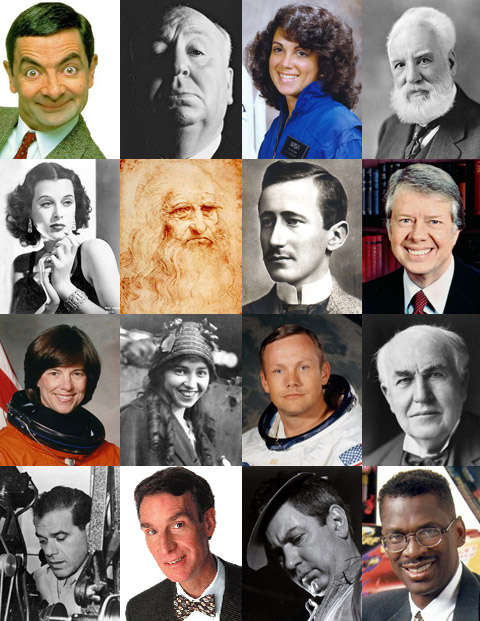
Professional Interview

A primary objective of the Principles of Engineering course is to give our students a perspective on the different fields of engineering one could persue beyond High School. What better way to work towards this awareness than to conduct an interview with an engineer?

A selection of interesting people with engineering backgrounds. How many of these people can you name?:


Overview
Conduct a personal interview with a professional in the field of engineering, engineering technology, or another high-tech, high-demand field. Interview documentation must follow the outline format described below and consists of three major components: Professional Background; Interview; Interviewer Reflection. Completed interview documentation must be posted to your online portfolio (blog).


1. Discuss with your instructor who you would like to interview. Obtain instructor approval.

2. Contact the person you will be interviewing and obtain consent.


Professional Background

3. Gather the information below. Use the buddy system for all interviews. No interviews are to be conducted in private

a. Interviewee name:

b. Interviewee’s specific degree:

c. Interviewee’s place of employment:

d. Interviewee’s email address and/or phone:


Professional Interview

4. Ask interviewee the questions listed below and record exact responses in your engineering notebook. If you wish to ask additional questions, seek instructor approval.

· Please describe your engineering field.


· What is your current job title?


· Please describe your particular job and duties.


· What is your average work schedule?


· Starting with high school, describe your educational background chronologically.


· If you had it to do over, related to your career or education, would you do anything differently?


· What advice would you give to me as someone interested in pursuing a career path similar to yours?


Personal Reflection

5. Reflect on your completed interview and answer the following questions. You may also add additional reflections or thoughts.

a. What surprised you the most about the interview?

b. What was the most important piece of information that you learned form the interview?

c. How has this interview influenced your feelings about your future career?

Tuesday, September 13, 2011

My First Blog Post!


We're getting all of our 2011-2012 students set up with their blogs. These will serve as an online portfolio of your engineering experiences.

Please Complete the following to make your blog:
1) Sign in to your Google account. Create one at www.google.com if you don't already have one.
2) Create a blog through www.blogger.com
3) Name your blog. Choose any school appropriate name that you like for your online portfolio. Since this is something that we hope will serve as a reference, please choose a title/web address appropriate to include on a resume. Consider the use of words like "Engineering", "Design", "Problem Solving", your name, etc.


Assignment for your first Post:
1) Title your post "My First Blog Post!"
2) Type some text greeting people that visit your blog.
3) Insert a photo of something you're interested in (hobby, sports team, technology, etc.)
4) Include a sentance or two of text before or after the photo explaining your interest.
5) Insert a link relavent to the photo.
6) Use the spell check feature to check your spelling.
7) Make sure your post is formated in a presentable way.
8) Add a Label to the post

Monday, September 12, 2011

Emergency Preparedness!


Thursday's county wide blackout and Sunday's 10 year anniversary of September 11th are powerful reminders that large scale emergencies can happen without warning. As designers, we will consider ways that we can be better prepared for life's unexpected events. This activity serves as an opportunity to apply the PLTW 12-step design process that is part of our Engineering and Design curriculum.


Task:
Use the 12-step Design Process discussed in class to develop an Emergency Preparedness Plan. Define the problem, brainstorm solutions, create a prototype, generate user feedback and then readjust your solution.


Criteria:
Prepare a list of essential items your family would like to have on hand for an emergency situation.
You may collaborate with your classmates in developing your plan.
Each student will prepare their own list.

Constraints:
Items required for the plan/list must be affordable for your family.


Assignment: Emergency Preparedness Supply List (5pts)
Prepare and complete the following on your blog. Ensure your product is organized and professional:

Define the Problem (1pt) - What types of emergency situations might you and your family need supplies for? Include an image at the top of your post related to one of them. List at least 3 types of emergencies you want to consider for your list.

Brainstorm Ideas (1pt) - List at least 20 ideas for supplies you could use for the given emergencies (number your ideas). Get input from at least one other student (list student next to any ideas they shared). Remember the rules of brainstorming is that there are no rules.

Generate a Solution (1pt) - Given the constraints listed above, generate a list of supplies for you and your family.

Solicit Feedback (1pt) - Get specific "+, delta, ? and !" feedback from your family. List who shared what input with you.

Refine your Solution (1pt) - Adjust your plan based on your feedback. Cite a specific change based on each category of feedback (+, delta, ? and !).

Tuesday, May 31, 2011

2nd Period Final

Greetings Engineers,

A game is a problem solving activity approached with a spirit of fun. Hopefully we can enjoy this final challenge for the year!


Phase 1: Design/Build (45 mins - 5pts)
Construct a ping pong ball launcher according to the following criteria and constraints:

Criteria
-Adjustable launch trajectory (use provided protractor).
-Be able to launch a ping pong ball within a range bracket of 10 to 20 feet.
-Be as accurate and precise as possible within this range window (significant to next phases)


Constraints
-Use provided materials (Fischertechnik, rubber bands, popsicle sticks, pipecleaners)
-No adhesives/tape (exception: you may tape the protractor to your design in order to more reliably read your launch angle)


Document your launcher by posting a photograph to your blog. Briefly list any key features of your design.


Phase 2: Test & Visualize Data (30 mins - 5 pts)
-Collect a minimum of ten data points (you may want to do more).
-Correlate launch angle with distance traveled.
-Put your data into Power Point and visualize it with a graph of Angle vs. Distance

Post your Power Point graph to your blog


Phase 3: Friendly Competition (30 mins - 5 pts)
We will hold a target practice tournament with our launchers. Competitors will be paired up and take turns to see who can be first to hit a target placed between 10 and 20 feet from their launchers. Winners will advance.

List how far you were able to advance in the tournament


Phase 4: Clean Up (15 mins - 5 pts)
Have your launcher fully broken down and parts returned to their bins by the completion of the period.

Wednesday, May 18, 2011

Survey Time


Our CHS Engineering Courses are offered through the county's Regional Occupational Program (ROP). We've been given the task of completing a survey for them.

Click here to take the ROP survey

Friday, March 25, 2011

Egg Drop Challenge: Iteration #1 Blog Post Write Up

(a list of team weights from our first annual Egg Drop Challenge. 5th period on the left, then 3rd and 4th period on the right. Click to enlarge.)


Below are instructions to help you structure your Egg Drop Challenge write up. Your write up will be scored for your grade on the activity.


1) Title your post "Egg Drop Challenge - Iteration #1"


2) At the top of your post list the following:
"Total # of Achievements Earned: X"
(where X is the number you earned)


3) Post an image of your Egg Drop solution.


4) Justify (list and explain) your Achievemtns. Use images as appropriate. For organization's sake, use the categories provided in the Egg Drop Achievement List.


5) What designs from your class did well? Based on the achievements you earned, how would you redesign your solution to score better? Be specific (sketches with labeling work well for this).

Friday, March 18, 2011

Engineering Program Investigation


A major goal of our high school level engineering experience is to open your eyes to the opportunities that are before you (and to inspire you to act on them!).

In support of that effort, choose a College/University you would be interested in attending. Choose an engineering program of interest from within that institution and investigate the course requirements. Post answers to the following questions on your blog.


Questions

College/University of interest:

Why does this institution appeal to you?:

Which engineering program is most interesting to you and why?:

Which undergraduate engineering elective is most interesting? Describe the course and its appeal to you:

Monday, March 14, 2011

Machine Control: Capstone Project


Deliverables / Portfolio report
These items are pulled directly from the worksheet you were given at the start of the project. Complete these tasks and post the results to your blog:


-Brainstorming Ideas: Provide at least four of your team’s brainstorming ideas for the design solution. This should include brainstorming sketches or electronic 3D models of your ideas. Each sketch should be signed, dated, and should include labels and descriptions for communication.

-Decision Matrix: Evaluate the four solution ideas using a decision matrix. Determine the best solution to the problem.

-Final Design Solution: Create a detailed pictorial sketch or use 3D modeling software to document the best solution, based upon your team’s decision matrix. Your sketch or 3D model should include a rationale for the design selected as the final design solution. Each sketch should be signed, dated, and should include labels and descriptions for communication.

-Design Modifications: If you change your final design solution, document the modifications. Explain the reason for the modifications and describe how the new design solution will solve the problem (refer to Design Modifications Chart).

-Final Design: This section will include information pertinent to the design solution in the form of images (e.g., photographs of final solution, photographs of testing solution, orthographic and isometric drawings, assembly, schematics, exploded views, written programs, flow charts, calculations, and data tables).

-Reflection: How well did you accomplish your objectives? What would your team do differently with your design solution and why? Do the results fulfill the problem statement? Provide a brief explanation of what you learned, the challenges of working in a design team, and the purpose of the design problem. The reflection should be 200-250 words.


****Update****
****Additional Questions Added****


- A Helping Hand: Since one of the major goals of our course is to expose students to working in a collaborative and open environment (like one might experience in a professional technical setting), I'd like to know if there were any students outside of your team that were especially helpful to your efforts. If you did recieve some help, please let me know who that was and be specific about how they helped you out. I will look positively on you for recognizing people that made a difference for you. Thanks.


- "Achievements" (Optional/Bonus): I'm going to create my own design brief for this activity in the future. I will use an "achievement system" much like this Egg Drop Challenge Achievement List (click through to see an example Achievement System). Do you have any good ideas for Achievements for the Machine Control Capstone Project? What materials were in short supply and how could you use Achievements to help control their use so everyone has some available?

Tuesday, March 8, 2011

TED pt I - Ideas worth Spreading?


Go to TED.com and spend some time investigating the site.

Once you've had a chance to familiarize yourself with the webpage, answer the following questions:

1) What is the TED organization about?

2) What is the purpose of their website and how does the functionality of their site support that?

3) As Engineers and Problem Solvers, which topic areas (the choices from the "Show talks related to:" section on the sidebar) are of most interest to us? Justify your answer.

4) Based on your previous answer, what are 3 talks (videos) on the site that appear like they would be of most interest to you as an Engineer/Problem Solver? Justify your choices.

5) Each student will watch a unique video. Claim your video on the following period specific posts: 2nd, 3rd, 4th, 5th. If no one else has claimed your video, leave a comment on that post to call the one you want. If someone else has already claimed the talk, go back and pick another one. Watch the video. Embed the video in your blog post and create a bulletized outline of the key issues presented in the talk.

6) How could you get involved in the field/technology/issue you chose to hear about? What experience/skills/training/education would you need to learn to get involved with this field?


Part II of the TED activity will have you negotiate within a group to select the "best" video to represent the group. The student with the chosen video will recieve extra credit. The group will then prepare a short presentation that summarizes the talk and will present to the class. The class will choose the best presentation and that group will recieve extra credit.

Wednesday, March 2, 2011

Professional Interview


Conduct a personal interview with a professional in the field of engineering, engineering technology, or another high-tech, high-demand field. Interview documentation must follow the outline format described below and consists of three major components: Professional Background; Interview; Interviewer Reflection.


1. Discuss with your instructor who you would like to interview. Obtain instructor approval.

2. Contact the person you will be interviewing and obtain consent.


Professional Background

3. Gather the information below.

a. Interviewee name:

b. Interviewee’s specific degree:

c. Interviewee’s place of employment:

d. Interviewee’s email address and/or phone:

Professional Interview
4. Ask interviewee the questions listed below and record exact responses in your engineering notebook. If you wish to ask additional questions, seek instructor approval.

· Please describe your engineering field.


· What is your current job title?


· Please describe your particular job and duties.


· What is your average work schedule?


· Starting with high school, describe your educational background chronologically.


· If you had it to do over, related to your career or education, would you do anything differently?


· What advice would you give to me as someone interested in pursuing a career path similar to yours?

Personal Reflection
5. Reflect on your completed interview and answer the following questions. You may also add additional reflections or thoughts.

a. What surprised you the most about the interview?

b. What was the most important piece of information that you learned form the interview?

c. How has this interview influenced your feelings about your future career?

Thursday, February 24, 2011

RoboPro: Subprograms and Meters

We're continuing our efforts at getting our heads around the capabilities of Robopro, our visual programing development environment.


The subprogram capability of the software will help us modularize our programing efforts by creating reusable functions we can apply to multiple programs.

Create a program that encapsulates the functionality from our previous lesson within a subprogram (incrementing a variable). Create a Main program that successfully uses your subprogram.

Use a meter and a text display to communicate your variable value on the main program screen.

Deliverables
-A concise sentence or two that summarizes the activity
-Screenshots of your program that show off the subprogram and metering

Conclusion
-What are the benefits of using subprograms within your team development projects?