Engineering Curriculum at Coronado High School: 2010 - 2014

Thursday, October 11, 2012

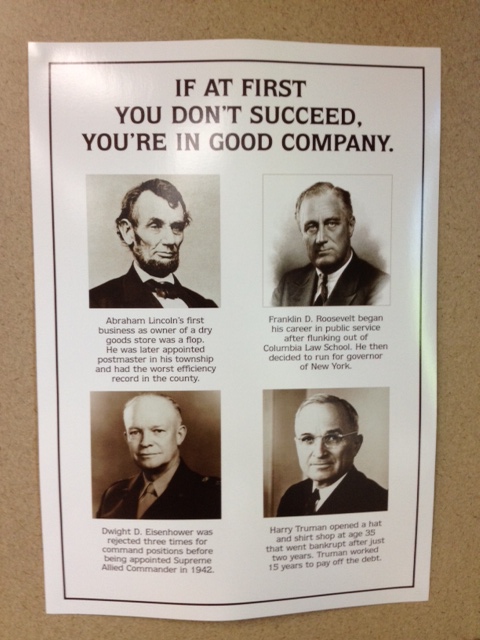
"Fail Early, Fail Often..."

...You all hear me say it nearly every day.

These leaders were all entrepreneurs in one way or another. What if they had waited to get everything "just right" before they attempted their early efforts?

Even though these first efforts were "failures", what do you think they learned from them? How might this "growth mindset" have helped them in their life and nation defining roles? Can you choose to have a "growth mindset"? How do champions like Michael Jordan or Tiger Woods react to set backs? Can you react the same?


CHS Photo Scavanger Hunt Challenge - Who's room is this poster posted in?

Thursday, October 4, 2012

Data Visualization

We'll watch this one on a rainy day:


What did you find most compelling in this presentation?

How could you present information in your future academic efforts to tell more of a "story"?

According to this data, what effect did increased quality/accessibility of health care have on countries' GDP?

Perspective

Chris in 3rd Period has drawn the best Perspective Sketch I've seen in my now third year of doing this activity. Nice job!


Wednesday, October 3, 2012

Mission Impossible: Federal Survey Card Competition!


UPDATE: Congratulations! 4th Period has persevered to achieve victory! This was a multifaceted effort and we can feel good that everybody came together to accomplish this goal. Nice work :)


Dear 4th Period Engineers,

Change of plan for our Federal Survey Card strategy! We designed our solution on incorrect information.

The cards may be turned in as soon as they are all collected. To be competitive, we will aim to turn them in before school!

This plan is complicated by the fact that I have an appointment in the morning and will not be in until 8:30... so I've devised a solution that ill let us remain competitive!


Do the following to help us achieve victory!:
1) Contact your agreed upon "buddy" to make sure they have completed their card and packed it for school. Please make sure they know we will now be turning them in before school!
2) Ensure your own card is complete and packed for school.
3) Return your card to the envelope in the folder taped to the Engineering classroom door (Rm 705). Do this before school! Mark off your name/number on the list on the holder once your card is in and arranged in the correct alphabetical/numerical order.
4) If you are the last student to return the card/check off on the list, immediately turn in the envelope of cards to Mrs. Kirk. If I am not in I can retroactively write a pass if you are on this task during first period.

The Stakes!:
If the class wins, we will lower the Term's grade threshold by 5 points. :)
If you fail to bring your card in, it was agreed that you owe the class cookies :)

Thank you, I look forward to celebrating a victory in the morning!

Mr. Olson

Rescue Ranger

I came across this critter yesterday afternoon. He had a fishing hook stuck in his mouth with line trailing off of it. Surely he would have died if I didn't make an effort to get him some help. I must have looked like a maniac scrambling around the low tide reef after him! I finally caught the guy and had the lifeguards pick him up to hand off to a wildlife rescue organization.

I mention this in context of our classes because it was a lesson in iterative design and perseverance. It took me many attempts and I nearly gave up. It was also a little intimidating to try and grab a wild critter. My first attempt was bare handed and that was too much for me. I got some gloves I keep in my car and felt much more capable with them. When I cornered the guy I used a feather off the ground to test his striking force and distance. Think of that as a "prototype" for my fingers! I didn't know what to expect. With better insight of what he was capable of I was ready to make the grab.


App Development Underway

Making some nice progress on app development in 4th Period:


Wednesday, September 26, 2012

The 3rd Annual CHS Cardboard Canoe Challenge! :)

Ladies and Gentlemen,

Welcome to the 3rd Annual CHS Cardboard Canoe Challenge. Do you have what it takes to design and build this year's winning watercraft?


(I lost all my photos from last year so imagine this is a cardboard canoe!)


Overview
Your class will break into teams to compete. You will design and build a solution to compete in the Challenge based on the bellow Criteria and Constraints. Safety is the number one priority in this event!


Safety
***Swimming is an “opt in” activity. No one has to swim if they don’t wish to. Swim only if you have the ability to do so. Appropriate attire is required for swimming. Adhere to the swimming facility rules. Safety is the top priority at all times.***


Criteria
• Build a watercraft that allows you to traverse the CHS swimming pool.
• Your "boat" must float at least one student through the course of the competition.
Protect your workspace from damage!

Constraints
• You may only use Cardboard and Duct Tape for this event.
• All Staples or other foreign material must be removed from your cardboard. If we trash the pool, we will not be invited back for other activities during the year (yes, we have other activities in mind for 2nd semester).
• Cardboard must meet our quality standard and be approved by the instructor (more info to follow)
• Each boat must have a minimum of a 3" tall "sidewall" (no completely flat designs).
• All exposed cardboard must be covered in duct tape (this will reduce cardboard disintigration in the pool).
• Each team will be provided one "versa table" cardboard box piece and three 60yrd rolls of duct tape. Any materials beyond this (likely need more cardboard) need to be resourced by your team.


Achievments
Create a comprehensive post on your blog that justifies the Achievements you've earned for this challenge.
Make sure you claim the total number of achievements you've earned at the top of your post!


Design Achievements:
Define the Problem and Brainstorm Solutions - State the problem you are designing a solution for. List at least 20 ideas you have regarding your solution.
Big Brain - The individual student with the most brainstorms listed will earn a bonus achievement.
Criteria & Constraints - List or reference the specified Criteria and Constraints you're designing for. List at least one implied criteria. List at least three implied contsraints.
Sketch Ideas - Draw 3 different sketches for possible designs. Label at least 3 key features for each sketch. Describe the feature's functionality so a viewer understands why the called out feature is important.
Prototype Ideas - Craft physical prototypes (models) of each of your three sketches. Use a notecard or post it note to call out at least one key feature on each model. Post the images to your blog and describe the key feature that you've pointed out on each.
Select an Approach - Generate feedback (+, change, ?, !) and make a decision matrix regarding your sketches/prototypes. Specify the approach you've chosen and justify your selection.
Surface area! - Calculate how much surface area you can cover with your given duct tape. How many sf can you cover with one roll? How many can you cover with all your rolls? What % efficiency do you think you can achieve with your overlap?


Build Achievements:
Build It! - Build your watercraft. Your build must meet the standards of construction (100% covered in Duct Tape). Document it with a presentable photo.
The Early Bird Gets the Achievement - Awarded to the team with the fastest build.
V-Bottom - Earn this by building a non-flat bottom


Test Achievements:
The Fastest - Awarded to the first team to reach the far side (25yds)
The Farthest - Awarded to the team that can travel the furthest (laps)
The Longest - Awarded to the team with the watercraft that floats the longest (multiple teams may be awarded this achievement if multiple boats remain afloat at the end of our competition period).
Balance Master - Awarded if you can have at least one person stand for 5 seconds in the boat (you must conduct this away from the edge of the pool so that non one falls over and hits their head)
Videographer - Take video of the challenge and post to your blog.


Reflection Achievements:
Feedback - Generate ten items of feedback for your effort (from the design/build process and/or the actual product). Make sure you include at least one item of feedaback in each of our four feedback areas (+, change, ?, !)
How Low Did You Go? - How low in the water did your canoe sit (roughly)? Was it suprising how little your boat went down in the water? What is the unit weight of water in pounds? How much did your pilot weigh (roughly)? Use math to help explain the depth that your boat sat in the water.
Redesign - If we were to do another Carboard Canoe race next semester, what would you build? Draw from everything you experienced in your class and propose the most competative solution. Include a sketch with key features and dimensions labeled.
(Make Your Own Achievement) - Make an achievement of your own design that you can award yourself for something awesome your team did. (Example "Transformer" - although our canoe sunk, our team was able to convert it into a surfboard style design and continue competeting!)


Friday, September 21, 2012

Fresh Hardware!

Wow... day of release and we have our first iPhone 5 in class... Neat!:


Monday, September 17, 2012

3rd Annual Mousetrap Racecar Challenge!


We've learned about a number of simple machines in the Principles of Engineering courses. A common theme amongst these devices is the concept of using mechanical advantage to trade force for distance or distance for force. How can we use this trade off in context in the classroom?

For this challenge you and a team mate will design, build and compete with a Mousetrap racecar. Specifically, you will use a third class lever and a wheel and axle simple machine to prototype a race vehicle.


Criteria:
Design, build and compete with a Mousetrap Racecar (A "car" uses at least two axles).
Maintain a clean workspace.

Constraints:
One mousetrap
No more than 12" of masking tape
Fischertechnique robotics parts
No more than 24" of string
All materials used must travel with your vehicle
You must work through the stages of the event (see Achievements below)
Additional materials by Instructor approval


Achievements (by stage):
Post your results for the Simple Machine Challenge pt I to your blog. Tally your total number of Achievements earned and justify each within the post. Your grade is the total number of Achievements you earn curved against the number of Achievements your classmates earn.


Design Stage:
"Brainiac" - Brainstorm solutions for your design. Generate a list of at least 10 ideas/concepts.
"Visualize It!" - Create a sketch of a design and label key features.


Build Stage:
"Build It" - Build your design. Document it with a photo.
"The Price of Glory" - If each part you use costs $1, generate a total cost for your build (This info will be used to generate "cost" data to add a pricing element to the game next year).

Test (Compete) Stage:
Each car will compete in two events. Generate your design accordingly.
1) The Distance Event: Compete for the furthest distance. Teams will race one at a time and have up to 3 attempts to achieve the longest distance. We will race on the tiles of the classroom unless the class decides we need more space. Your best result will be marked with a piece of masking tape. The marked location is where the car comes to rest (cars have been known to roll back at times!).
2) The Acceleration Event: Cars will compete head to head in a competitive bracket. The winner of each duel will move on to the next round. The course is 24" long.

"Competitor" - Compete in the 2nd Annual Mousetrap Racecar Challenge.

"Long Distance Winner!" - Travel the furthest in the distance race.
"Going the Mile!" - Travel the furthest or second furthest in the distance race.

"Led Foot" - Be the team to win the acceleration bracket.
"Heavy Foot" - Be the team to win or finish second in the acceleration bracket.

"Feedback" - Collect feedback (at least one each of +, change, ? and !) from yourself or your classmates.


Iterate Stage:
"Re-work" - Change your build based on your experience with the race/feedback you collected. Document any changes.
"Game Changer" - Develop a new rule or change to the game that you feel would make the event better. Explain your concept.
"Name it" - Invent a name for an achievement that you think is better than what we have currently.


Clean Up Stage:
"Leave It Cleaner Than You Found It" - Did you leave your workspace cleaner than you found it? Explain.


Reflection Stage:
"Design/Build" - What is a "Design/Build" process? How did your experience with this challenge relate to that? Why might you experience this in a career related to technical innovation?


There may be an option to compete again (with the same or new rules) depending on the input we receive from the teams and the timeliness with which we complete the event.

Wednesday, September 5, 2012

Everyone Works in CHS Engineering :)

And Back to School Night is no exception! Your parents got to participate in our Card Tower Challenge. Game based problem solving is the metaphor for our experience in class so this gives them a tangible experience while we talk about the course and the year ahead.


Thursday, June 7, 2012

Congrats 2012!

Congratulations to our graduating seniors and to all of our CHS-ers who advance to the next rung!

Thanks to all for a great year :)


Thursday, May 17, 2012

Monday, May 14, 2012

Educating the Next Steve Jobs

"How can schools teach students to be more innovative? Offer hands-on classes and don't penalize failure." 'Fail early, fail often' is my mantra and I'm glad to see someone from the Wall Street Journal thinks I'm on the right path with all of you... Read the article here.

The "Architecture Project" - Human Centered Design in Action!

Goals:
Develop a design that meets the following Criteria and Constraints...

Criteria:
-Develop an architectural solution that solves a specific problem for a client. Your end result will be an architectural model of your design.
-Create 3 sketches to support your brainstorming effort.
-Create 2 digital prototypes of your design.
-Physically construct a prototype (model).
-Collect feedback from the client at each stage of your effort.

Constraints:
-Utilize a design process to solve this challenge:
----Define the Problem
----Brainstorm Solutions
----Digital Prototypes
----Physical Prototype
----Portfolio Report/Summary of experience
-All students on a team must meet with the client... this is "human centered" design after all!
-Clearly identify the design need being met.
-Use our "four quadrant feedback" technique with your client between each stage of the design process (Define the Problem, between Brainstorming and Digital Prototyping, between Digital Prototyping and Physical Prototyping, After completing your Physical Prototype). Your meetings can be breif, but please solicit feedback and incorporate it into your efforts. Record and list feedback at each stage and list any changes made based off of it.
-Label at least 3 key features on any sketches you produce.
-Use Inventor (CAD) on at least one of your digital prototypes. You may use Minecraft to quickly simulate the second digitial prototype.


Consider the following as you make progress on your effort:
-Can you utilize any of the "Design Modes" from the Stanford Design School's "Design Thinking" process? Read our post on the "Bootcamp Bootleg" for more info.
-Can you incorporate any of the architectural concepts that were highlighted by our "Top Ten Architects" lesson?


The following process may help you achieve compliance with the above design criteria/constraints...

Process:
Identify a client
Discover a design need (interview the client)
Brainstorm solutions
-Create 3 sketches of solutions.
-Call out 3 key features on each sketch.
Prototype 2 solutions with CAD software
-Consider 'A/B testing' a key design feature.
Recieve feedback from your client
-generate "+", "change", "ideas" and "questions" from both your client and your team.
Rework/Iterate on your design
-incorporate feedback into your design.
-call out features you changed based on specific feedback.
Build an architectural model that incorporates feedback
Present model for review
-generate another round of feedback.
Write up experience on your online portfolio
-Share client feedback at each stage of the effort. Communicate how feedback shaped your next effort in the design process.

Wow...

The Engineering Projects course is going to be focused on developing a UAV next year. These UAVs being developed at University of Pennsylvania are mindblowing!:

Tuesday, May 1, 2012

RC Flyers

Process:

Watch the "Scratch Built" video below.
-Generate a list of materials you anticipate using based on their design.

Brainstorm solutions for your own design.
-Sketch three possible designs.
-Call out 3 key features on each design.

Build a Manila Folder prototype.
-Why would this be helpful to your build?
-Assess results and incorporate feedback.

Build a First Foamboard Prototype without electronics.
-Your design must have dihedral in the wings.
-Test glide characteristics of First Foamboard Prototype.
-Assess results and incorporate feedback.
-You must demonstrate that your design will glide (not plummet) in an underpowered scenario.
-Balancing is key.
-Tune design and weighting to find center of gravity.
-Mark your center of gravity!

Load Electronics.
-Maintain center of gravity!
-Conduct powered test flight. Rad!!!
-Assess results and incorporate feedback.

Share Results
-Write up Process
-Generate material to share Product.