

Friday, September 2, 2011
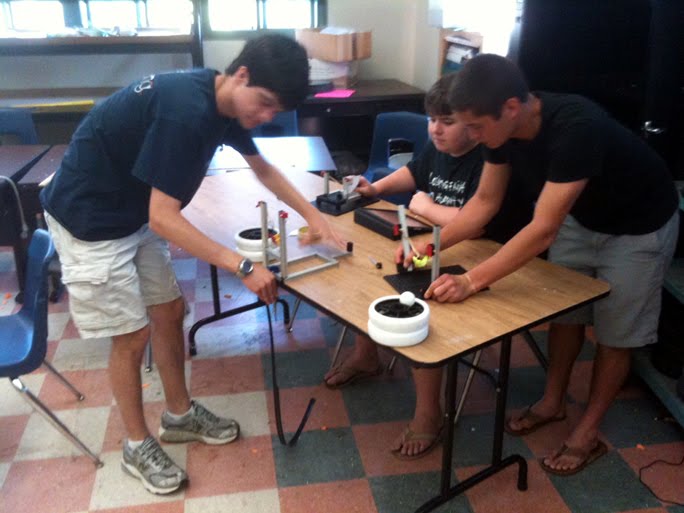
Simple Machine: Wheel and Axel
Andrew and Isabel show off a very clean design for the examination of a Wheel and Axel simple machine:


Wednesday, August 31, 2011


Tuesday, August 30, 2011
Everyone Works in CHS 705
Room 705 is where work gets done. It wouldn't be fair to have your parents visit for Parent Teacher Night and not put them to work.
What will I have them do?:

Card Tower Game underway:


This was one of the talest towers completed by the parents. Were you able to beat that?:

? - Why would I have your parents participate in the Card Tower Game? What are three purposes this activity served?
What will I have them do?:

Card Tower Game underway:


This was one of the talest towers completed by the parents. Were you able to beat that?:

? - Why would I have your parents participate in the Card Tower Game? What are three purposes this activity served?
Monday, August 29, 2011
What Makes an "Engineering Project"? - PT I - Ping Pong Launcher Challenge
To get the year going, we're going to revisit the POE Final Challenge from the last day of class last year.
This is a great opportunity to start working with a team and see how we can take data, visualize it and then use the data to make choices regarding overcoming a challenge. This is a "game" so please approach the challenge with a spirit of fun! I hope we can enjoy kicking off the year with this as a first (of at least two) warm up project(s).
Phase 1: Design/Build
Construct a ping pong ball launcher according to the following criteria and constraints:
Criteria
-Adjustable launch trajectory (use provided protractor) or adjustable pull.
-Be able to launch a ping pong ball within a range bracket of 10 to 20 feet.
-Be as accurate and precise as possible within this range window (significant to next phases)
Constraints
-Use provided materials (Fischertechnik, rubber bands, popsicle sticks, pipecleaners)
-Limited adhesives/tape - no major structural dependency on tape
Document your launcher by posting a photograph to your blog. Briefly list any key features of your design.
Phase 2: Test & Visualize Data
-Collect a minimum of ten data points (you may want to do more).
-Correlate launch angle or pull distance (depending on which design you pursued) with distance ball traveled.
-Put your data into Power Point and visualize it with a graph of Angle/pull vs. Distance
Post your Power Point graph to your blog
Phase 3: Friendly Competition
We will hold a target practice tournament with our launchers. Using a competitive bracket, teams will be paired up and take turns to see who can be first to hit a target placed between 10 and 20 feet from their launchers. Winners will advance.
List how far you were able to advance in the tournament
Phase 4: Clean Up
Have your launcher fully broken down and parts returned to their bins by the completion of the period.
Basic Data Visualization
Very straightforward but I'd like to see each Engineering Projects visualize data in one of the two formats shown below (pull or trajectory vs impact distance) for their Ping Pong Launcher entry. Please let me know if you have any questions!


Friday, August 26, 2011
Haze Fest
Wow... I'm glad I wasn't new this year...

Kudos to the new teachers for their bravery! Welcome aboard!

Kudos to the new teachers for their bravery! Welcome aboard!
Thursday, August 25, 2011

Thursday, June 2, 2011
Happy Graduation!
Thanks for a fantastic year!
It was a gorgeous evening for an auspicious occasion.
I recieved some very meaningful feedback this evening. It's difficult to be everything for everyone and I'm proud to have made a positive difference for as many as I did.
Thank you for the opportunity... have a great summer!
The stands are filled with family and friends well before the ceremony starts:

A stunning backdrop for Mr. Mueller's talk:

The Seniors will be missed.
Looking forward to next year!
It was a gorgeous evening for an auspicious occasion.
I recieved some very meaningful feedback this evening. It's difficult to be everything for everyone and I'm proud to have made a positive difference for as many as I did.
Thank you for the opportunity... have a great summer!
The stands are filled with family and friends well before the ceremony starts:

A stunning backdrop for Mr. Mueller's talk:

The Seniors will be missed.
Looking forward to next year!
Wednesday, June 1, 2011
Period 3 & 5 Final Challenge
Greetings Engineers,
Here is a final engineering design challenge to wrap the year up with a bang!
You have the next two hours to exercise your creative and technical skills on this problem.
Challenge: Many members of the CHS Senior class will be heading off to college in the fall. Once at school, bicycles will be the primary mode of transportation for most. Student housing is often cramped. How can students store their bike inside without impacting their and their roommates living space?

Design a Bicycle storage system that allows a student to keep their bike indoors without taking up major space in their living areas.
Utilize the design process we've learned this year to generate a solution to this problem.
Post the following to your online portfolio (15 points):
-Define the Problem (1pt)
-Brainstorm Solutions (2pts)
-Define Criteria and Constraints (2pts)
-Generate Sketches (2pts)
-Select an Approach: Use a Decision Matrix to justify your approach (2pts)
-Model your solution with CAD software: Post an Isometric view of your assembly and a multiview drawing. (3pts)
-Use the 4 Quadrant Feedback technique to assess your model (3pts)
Here is a final engineering design challenge to wrap the year up with a bang!
You have the next two hours to exercise your creative and technical skills on this problem.
Challenge: Many members of the CHS Senior class will be heading off to college in the fall. Once at school, bicycles will be the primary mode of transportation for most. Student housing is often cramped. How can students store their bike inside without impacting their and their roommates living space?

Design a Bicycle storage system that allows a student to keep their bike indoors without taking up major space in their living areas.
Utilize the design process we've learned this year to generate a solution to this problem.
Post the following to your online portfolio (15 points):
-Define the Problem (1pt)
-Brainstorm Solutions (2pts)
-Define Criteria and Constraints (2pts)
-Generate Sketches (2pts)
-Select an Approach: Use a Decision Matrix to justify your approach (2pts)
-Model your solution with CAD software: Post an Isometric view of your assembly and a multiview drawing. (3pts)
-Use the 4 Quadrant Feedback technique to assess your model (3pts)
Tuesday, May 31, 2011
2nd Period Final
Greetings Engineers,
A game is a problem solving activity approached with a spirit of fun. Hopefully we can enjoy this final challenge for the year!
Phase 1: Design/Build (45 mins - 5pts)
Construct a ping pong ball launcher according to the following criteria and constraints:
Criteria
-Adjustable launch trajectory (use provided protractor).
-Be able to launch a ping pong ball within a range bracket of 10 to 20 feet.
-Be as accurate and precise as possible within this range window (significant to next phases)
Constraints
-Use provided materials (Fischertechnik, rubber bands, popsicle sticks, pipecleaners)
-No adhesives/tape (exception: you may tape the protractor to your design in order to more reliably read your launch angle)
Document your launcher by posting a photograph to your blog. Briefly list any key features of your design.
Phase 2: Test & Visualize Data (30 mins - 5 pts)
-Collect a minimum of ten data points (you may want to do more).
-Correlate launch angle with distance traveled.
-Put your data into Power Point and visualize it with a graph of Angle vs. Distance
Post your Power Point graph to your blog
Phase 3: Friendly Competition (30 mins - 5 pts)
We will hold a target practice tournament with our launchers. Competitors will be paired up and take turns to see who can be first to hit a target placed between 10 and 20 feet from their launchers. Winners will advance.
List how far you were able to advance in the tournament
Phase 4: Clean Up (15 mins - 5 pts)
Have your launcher fully broken down and parts returned to their bins by the completion of the period.
A game is a problem solving activity approached with a spirit of fun. Hopefully we can enjoy this final challenge for the year!
Phase 1: Design/Build (45 mins - 5pts)
Construct a ping pong ball launcher according to the following criteria and constraints:
Criteria
-Adjustable launch trajectory (use provided protractor).
-Be able to launch a ping pong ball within a range bracket of 10 to 20 feet.
-Be as accurate and precise as possible within this range window (significant to next phases)
Constraints
-Use provided materials (Fischertechnik, rubber bands, popsicle sticks, pipecleaners)
-No adhesives/tape (exception: you may tape the protractor to your design in order to more reliably read your launch angle)
Document your launcher by posting a photograph to your blog. Briefly list any key features of your design.
Phase 2: Test & Visualize Data (30 mins - 5 pts)
-Collect a minimum of ten data points (you may want to do more).
-Correlate launch angle with distance traveled.
-Put your data into Power Point and visualize it with a graph of Angle vs. Distance
Post your Power Point graph to your blog
Phase 3: Friendly Competition (30 mins - 5 pts)
We will hold a target practice tournament with our launchers. Competitors will be paired up and take turns to see who can be first to hit a target placed between 10 and 20 feet from their launchers. Winners will advance.
List how far you were able to advance in the tournament
Phase 4: Clean Up (15 mins - 5 pts)
Have your launcher fully broken down and parts returned to their bins by the completion of the period.
Friday, May 27, 2011
1680 lbs of Engineering Students
The framing of this year book photo doesn't really tell the story but that's 1680 lbs of 5th Period on the large classroom scale:


Thursday, May 26, 2011

4th Period!
Our last day in class with our Seniors. Congrats on making it through 13 years of school! Here's 4th Period taking a break from their Capstone projects to get this photo:


Tuesday, May 24, 2011
3rd Period!
Here we are with all of 3rd Period. Today is the last day for our Seniors so it's great to have a photo with the whole class in it.
Congratulations Seniors!

Congratulations Seniors!

Moons over My Hammy
Steven, George and Trenton took full advantage of the offer to bring food in for a party today.
Here they are cheffing up some great breakfast food! Nice job guys:

Here they are cheffing up some great breakfast food! Nice job guys:

2nd Period!
We got a great class photo today in honor of our last class with our Seniors.
Good luck Seniors! Thanks for a great year!:

Good luck Seniors! Thanks for a great year!:

Monday, May 23, 2011
AP Physics Top 20
Tommorow is our final day of engineering class for many of our Seniors. I wanted to pick everyone's brains for ideas on projects I could facilitate in next year's course that would support these important concepts that Mr. Lemei has identified for the AP Physics test:


Harder, Better, Faster... Smaller?
Making Things Smaller. Part 2 of the Making Things series from NOVA:
Watch the full episode. See more NOVA.
Wednesday, May 18, 2011
Survey Time

Our CHS Engineering Courses are offered through the county's Regional Occupational Program (ROP). We've been given the task of completing a survey for them.
Click here to take the ROP survey
Monday, May 16, 2011
The Truth About Innovation
Besides having authored the insightful "Tipping Point", Malcolm Gladwell is a staff writter for the New Yorker magazine. In the latest issue he digs deep into the subject of innovation in his article Creation Myth.:

Malcolm has an engaging interview on NPR today that supports the article. He discusses how being first isn't likely to be the best place to be with delivering a new idea/product. For instance Apple, America's largest tech company, has been a blockbuster success being 2nd and 3rd on many technologies (Window based OS, MP3 players, smartphones, etc.). Listen to the interview here.

Malcolm has an engaging interview on NPR today that supports the article. He discusses how being first isn't likely to be the best place to be with delivering a new idea/product. For instance Apple, America's largest tech company, has been a blockbuster success being 2nd and 3rd on many technologies (Window based OS, MP3 players, smartphones, etc.). Listen to the interview here.
Subscribe to:
Posts (Atom)